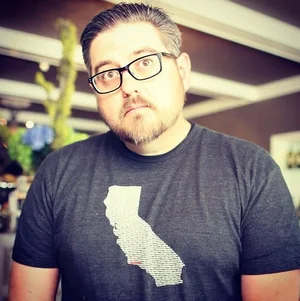
🎙️ Episode 49 🍷 Larry Schaffer | Curiosity, Community, and Why Wine Should Be Fun

Chopping It Up with Keith Saarloos · Released May 29, 2026 · Santa Ynez Valley, California
About this conversation
There are people who make wine.
And then there are people who spend their lives asking questions.
This week on Choppin' It Up, Keith sits down with one of the most outspoken, thoughtful, and genuinely curious people in the Santa Barbara County wine industry...
Larry Schaffer of Tercero Wines.
Before Larry was a winemaker, he was working in the music business.
Before that, he was a kid from Los Angeles who didn't grow up around wine at all.
Then one day he decided to do something most people never do.
He started over.
Larry walked away from a successful career, went back to school, moved to the Santa Ynez Valley, and built a wine brand from scratch because he believed life was too short to spend doing something he didn't love.
What follows is less of a wine conversation and more of a conversation about life.
🍷 Why wine should never make people feel intimidated
🎸 The similarities between music, art, and wine
🤔 Why curiosity keeps people young
🔥 Why groupthink is dangerous
🌱 The future of Santa Barbara County wine
🏔️ Why the Santa Ynez Valley remains one of the most unique wine regions in the world
💬 Social media, storytelling, hospitality, and the lost art of conversation
Most of all, Larry makes a compelling argument for a simple idea:
Drink what you like.
Like what you like.
And stop worrying about what everyone else thinks.
This episode is about wine.
But it's really about curiosity.
And curiosity might just be one of the most important things we lose as adults.
Pull up a chair.
Bring an opinion.
Larry probably has a different one.
From Keith’s original Valley archive
The following material is preserved from the original episode post. Existing transcript text is an archive copy and may contain transcription errors.
Episode 49 : Larry Schaffer | Tercero Wines, Rhône Varieties, and the Evolution of Santa Barbara Wine
In Episode 49 of Choppin' It Up, Keith Saarloos sits down with Larry Schaffer, founder and winemaker of Tercero Wines, for an in-depth conversation about Santa Barbara County wine, Rhône varieties, and the remarkable growth of the Santa Ynez Valley wine region.
Widely recognized as one of the leading voices in Central Coast wine, Larry shares his journey from the corporate world into professional winemaking and explains how he built Tercero Wines into one of California's most respected producers of Grenache, Syrah, Mourvèdre, Viognier, and other Rhône varietals. The discussion explores vineyard sourcing, wine growing, small-lot winemaking, and the philosophy that has made Larry a favorite among wine collectors, sommeliers, and enthusiasts throughout Santa Barbara Wine Country.
Keith and Larry dive into the history of Santa Barbara County wine, the pioneering winemakers who helped establish the region's reputation, and the unique terroir found throughout the Santa Ynez Valley, Ballard Canyon, Los Olivos District, Sta. Rita Hills, and Happy Canyon AVAs. They discuss how the Central Coast wine industry evolved from a small agricultural community into one of the most respected wine destinations in the United States.
Along the way, the conversation covers entrepreneurship, business leadership, hospitality, vineyard management, wine marketing, restaurant culture, risk-taking, and the importance of building authentic relationships in both wine and business. Larry shares lessons learned from decades in the wine industry and offers insight into what separates truly great wineries from the rest.
Whether you're interested in Santa Barbara wine, California winemaking, Rhône varietals, vineyard farming, wine entrepreneurship, or the future of the American wine industry, this episode provides a fascinating look at the people and stories behind one of the most influential wine regions in the world.
-
Summery
Episode 50: Larry Schaffer — Tercero Wines, Santa Barbara County Wine, and Why Curiosity Matters
In Episode 50 of Choppin' It Up with Keith Saarloos, Larry Schaffer, founder and winemaker of Tercero Wines in Los Olivos, joins the show for an in-depth conversation about Santa Barbara County wine, the Santa Ynez Valley, winemaking, hospitality, and the future of the wine industry.
Before becoming one of the most respected voices in California wine, Larry built a successful career outside the industry before making the life-changing decision to return to school, study viticulture and enology, and pursue his passion for winemaking. Today, Tercero Wines is known for Rhône varietals, small-lot production, vineyard-focused wines, and Larry's commitment to education, authenticity, and community.
Keith and Larry discuss what makes Santa Barbara County one of the most unique wine regions in the world, from its diverse microclimates and world-class vineyards to the independent wineries, family-owned businesses, and owner-operated tasting rooms that define the region. They also explore the challenges facing modern wineries, changing consumer habits, wine tourism, direct-to-consumer sales, and the importance of creating meaningful experiences around wine.
The conversation dives into topics including wine education, wine critics, wine tasting culture, hospitality, storytelling, social media, entrepreneurship, and why wine should be approachable and enjoyable for everyone. Larry shares his perspective on wine snobbery, the importance of curiosity, and why the best conversations often happen around a table with a bottle of wine.
Whether you're interested in Santa Barbara County wineries, Los Olivos wine tasting, Rhône wines, California winemaking, wine tourism, entrepreneurship, hospitality, or the people shaping the Santa Ynez Valley, this episode offers a fascinating look at one of the region's most thoughtful and outspoken winemakers.
Topics Covered
-
Who is Larry Schaffer?
-
The story behind Tercero Wines
-
Santa Barbara County wine history
-
Santa Ynez Valley wineries
-
Los Olivos wine tasting
-
Rhône varietals in California
-
Wine education and wine culture
-
Hospitality in the wine industry
-
Wine tourism in Santa Barbara County
-
Direct-to-consumer wine sales
-
Entrepreneurship and career reinvention
-
The future of California wine
-
Why curiosity is essential for success
-
Building community through wine
Frequently Asked Questions
Who is Larry Schaffer?
Larry Schaffer is the founder and winemaker of Tercero Wines, a boutique winery based in Los Olivos, California. He is known for his Rhône-inspired wines, wine education efforts, and leadership within the Santa Barbara County wine community.What is Tercero Wines?
Tercero Wines is a Santa Barbara County winery specializing in Rhône varietals and small-lot wines sourced from some of California's most respected vineyards.Why is Santa Barbara County wine unique?
Santa Barbara County features a rare east-west mountain range, diverse microclimates, long growing seasons, and the ability to successfully grow everything from Pinot Noir and Chardonnay to Syrah, Grenache, and Cabernet Sauvignon.What makes Los Olivos a popular wine destination?
Los Olivos is one of California's premier wine-tasting destinations, featuring dozens of tasting rooms, family-owned wineries, restaurants, hotels, and easy access to vineyards throughout the Santa Ynez Valley.What does Larry Schaffer believe about wine?
Larry believes wine should be approachable, enjoyable, and free from judgment. His philosophy is simple: drink what you like, share it with people you enjoy, and don't worry about what anyone else thinks.This episode is a conversation about wine, but it's also about curiosity, community, lifelong learning, and the people who make the Santa Ynez Valley such a special place to live, work, and visit.
-
-
Topics Covered
-
Larry Schaffer and Tercero Wines
-
Santa Barbara County wine history
-
Santa Ynez Valley wine country
-
Rhône varieties: Grenache, Syrah, Mourvèdre, and Viognier
-
Los Olivos wineries and wine tasting
-
Ballard Canyon AVA
-
Central Coast wine industry
-
Vineyard management and grape growing
-
Wine entrepreneurship and leadership
-
Hospitality, restaurants, and wine culture
-
California winemaking
-
Building a successful winery
-
-
FAQ
Who is Larry Schaffer?
Larry Schaffer is the founder and winemaker of Tercero Wines in Los Olivos, California. He is known for producing Rhône varietal wines, promoting Santa Barbara County wine, and serving as one of the region's most respected wine educators and advocates.
What is Tercero Wines?
Tercero Wines is a boutique winery based in Los Olivos, California, specializing in small-lot wines sourced from some of Santa Barbara County's most acclaimed vineyards. The winery is particularly known for Rhône varietals including Grenache, Syrah, Mourvèdre, Viognier, and Grenache Blanc.
How did Larry Schaffer get into wine?
Larry Schaffer did not grow up in the wine industry. After successful careers in the music and publishing industries, he returned to school, earned a degree in Viticulture and Enology from UC Davis, and moved to Santa Barbara County to pursue a career in winemaking.
Why did Larry Schaffer choose Santa Barbara County?
Larry chose Santa Barbara County because of its unique wine culture, diverse vineyards, collaborative community, and ability to produce world-class wines. He was drawn to a region that focuses on vineyards, farming, and quality rather than prestige and status.
What types of wine does Tercero Wines produce?
Tercero Wines produces a wide range of Rhône-inspired wines including Grenache, Syrah, Mourvèdre, Grenache Blanc, Viognier, Roussanne, Rosé, and other small-lot wines sourced from top vineyards throughout Santa Barbara County.
What does Larry Schaffer believe about wine?
Larry believes wine should be approachable, enjoyable, and free from judgment. His philosophy is simple: drink what you like, share it with people you enjoy, and don't worry about what anyone else thinks.
What makes Santa Barbara County wine unique?
Santa Barbara County is one of the most diverse wine-growing regions in the world. Its east-west mountain ranges, cool Pacific Ocean influence, long growing season, and varied soils allow growers and winemakers to produce exceptional wines from both cool-climate and warm-climate grape varieties.
What is the Rhône Rangers organization?
The Rhône Rangers is a nonprofit organization dedicated to promoting Rhône grape varieties grown in the United States. Larry Schaffer serves as a leader within the organization and is a passionate advocate for Rhône-style wines.
Why is Larry Schaffer considered an important voice in California wine?
Larry is known for his willingness to challenge industry norms, advocate for consumers, promote Santa Barbara County wine, and encourage open conversations about wine culture, hospitality, and education. His thoughtful and often contrarian perspective has made him a respected voice throughout the wine industry.
What did Larry Schaffer discuss on Choppin' It Up with Keith Saarloos?
Larry Schaffer discussed his journey into winemaking, the founding of Tercero Wines, Santa Barbara County wine history, wine education, hospitality, curiosity, social media, wine culture, the Rhône Rangers, and why wine should be fun, approachable, and accessible to everyone.
-
THE Transcript
Everybody, it's 10 AM on a Saturday morning and that means it's time to chop it up on one O 5.9 crazy country.
I'm your host, Keith Sarlos, and every week we get together with someone in the San Ynez Valley.
That makes it a very, very special place.
Sometimes it's people that are famous, sometimes it's restaurants, sometimes it's just people with great stories that they want to share.
0:21
And today we have a Vitner, we have a winemaker, we have Larry Schaefer, the mouth of the San Ynez Valley.
I hope we can keep this to 1/2 hour.
I'm I can sit back and just let, let Larry talk about the world and the state of the industry.
0:37
Larry's been a wine maker here in the San Diego Valley.
For how long now, Larry?
About 20 years. 20 years, a lifetime, a lifetime.
A second lifetime.
Second lifetime.
So tell us a little bit about yourself, Larry, for everybody who's listening, but also tell us a little bit about your brand and what brought you the saying as Val.
0:54
Sure, So I grew up in the South Bay of LA, did not grow up in a family that drank wine at all, so it was not part of culture whatsoever in high.
School I took pictures of.
Punk band in the LA music scene and I really wanted to get into music.
I started at UC Davis as an undergrad but again because of no interest in wine, wasn't thinking that route.
1:15
I was pre business which basically meant agricultural economics.
Probably would have been a smart thing to do but I didn't.
I ended up transferred.
To UC Berkeley graduating.
From the Haas Business School and my first job out of school.
Was with the largest record.
Distribution company in the world, who was that?
1:31
We are Warner Electric, Atlantic, they own sire slash, you name it islands sounded better than it was.
So I was on the finance side and I really wanted to get into the marketing side.
I listen, I've got a great vinyl collection from that I've got it was it was it was a good time in some ways, but I really wanted to get involved in marketing.
1:53
Being a number cruncher is not what I do.
And after 2 years, a couple of marketing positions became available.
One was given to a guy who worked his way up from the warehouse for seven years.
I'm like cool the and I had the CF OS backing.
I had my boss's back.
And the other was given to a woman who got along really well with the sales manager, wasn't working for the company at the time, and I was young and idealistic.
2:14
I'm like I'm out and I'll never forget when I.
Decided to leave the other.
People in my department like, well, how can you leave?
I'm like, how can you not?
They were so entrenched in their job and it was, you know, as a young 23.
I was.
It was eye.
Opening that people were stuck in their ways.
2:29
I'm like, I, I cannot do that.
I went into publishing, educational publishing and then trade publishing.
And about 25 years ago, I just got to a point where I wasn't happy.
Life was not challenging me whatsoever.
Started having kids, I really felt it was important to show them that you should enjoy what you do on a daily basis.
2:48
And again, wine was not part of my world, but I had gotten into wine.
I'm not a wine collector.
I'm just fascinated by the process.
I I had also never created anything and the concept of taking it, taking up taking something raw and making a product is something that is so darn cool.
3:08
And so I started going back to school, living in Orange County, taking classes at junior colleges with kids who could have been my kids.
OCC.
No Irvine Valley in Rancho Santiago.
Got it, Got it.
I did that for two years, worked part time at Temecula at a couple of wineries and then transferred back to UC Davis to get my masters in viticulture immunology.
3:26
So I kind of took it head on.
I realized that science wasn't that challenging as much as I thought it was at 18.
And then I moved up here.
So moved up here in 2005.
I really had no other.
I had interviews elsewhere.
I could have gotten a job in Napa.
3:42
I could have gotten a job in Sonoma.
I moved here because.
Of the vibe of this place.
And the fact that it's more about the product and less about the pomp and circumstance.
And I still feel very strongly about that.
And I've not worked anywhere else since.
3:57
I worked at Fess Parker for about 8 vintages, 9 vintages in the left to concentrate 100% of my own brand.
Yeah.
And my own brand's called Tercero means third in Spanish.
I'm a third child.
I was I.
Had three kids.
But I recently got remarried and I have a fourth, so I kind of screwed that up.
4:16
And then when I went to School of Davis's undergrad, the dormitory complexes were primero, segundo, tercero Y corto.
So I lived in tercero.
Third is 3 is not my favorite number.
Any kid my age you played soccer, 10 was your favorite number cuz that was Pele.
No one wanted to be a fullback and it just kind of stuck.
4:31
So I've been making wine since 2006, but it's really been since 1314 that have concentrated 100% of my own brand.
I've been a member of the Santa Barbara County Vendors Association.
I've been a huge Homer for this area.
I'm involved in an organization called the Roan Rangers, which is an advocacy group for roan varieties grown domestically.
4:52
I'm president of that board right now.
I put myself behind those things I feel strongly about in Santa Barbara County.
Wine is certainly something I feel incredibly strongly about.
One of the things, one of the reasons I wanted to have you on here is I've known you almost 20 years.
I mean a very, very long time now.
5:09
And when you were a lab rat over at Fess Parker way back in the day, you always had something to say.
You always had a great take on something.
You always had a great opinion.
And back in the day when it before you know, even before Facebook and everything else, you were right there in the message boards.
5:24
You know what I mean?
You were sharing thoughts.
You were at the best way I can possibly say it is you are a community builder, you like to be a part of a community and you want to be in the mix.
Would you say that's correct?
I I would say that, but I also definitely play a devil's advocate role.
5:41
Oh yeah.
And and I think.
Oh, you're my favorite contrarian.
I think every community needs that nowadays more than ever.
I think group think has become way too strong.
And that definitely is true in wine, but it's true in so many other things.
So I'm and also I, I love conversation.
5:58
And one of the reasons I make wine, wine is a conduit for conversation.
Pure and simple.
It's on the table.
Something to talk about.
Something to talk about and something to be a not necessary to the focus.
It doesn't have to be the focus.
But it creates.
Conversation around it and I just always loved that I'm I am the.
6:15
Stupid guy who still gets on the social media.
And gets on the political discussions with people because at the end of the day, I don't unfriend people unless they get nasty because I need to hear different opinions than my own.
The only way we understand the world is by understanding those outside of our realm.
6:31
If we only stick, and that's what happens these days, is everyone kind of sticks within their own little world.
And that's happening in the wine business too, for sure.
Let's take it.
I want to talk about your little hot take that you had recently that I watched the video and I was like, way to go, Larry, where you were talking about, you know, wine in general, but really the negative, you know, negative nancies of the wine world versus really having constructive conversations about wine.
6:58
At the core of wine, everyone in our industry claims that you should drink what you want to drink.
Sure.
And I think 3040.
Years.
Kind of like listen to what you want to listen.
Kind of like that kind of and I think. 30-40 years ago.
7:14
There was more open mindedness.
With regards to that.
Really.
I know, hot.
Hot, hot take by Larry.
Nothing I'm saying is earth shattering.
Nothing I'm saying is rocket science.
It's really, really simple.
It's an absolute for me.
7:30
I don't care what you drink, I don't care how you drink it.
But as a member of the wine community, people look towards me and you and Psalms and online wine.
Educators as experts.
And when an expert pans a certain wine and you like that wine, well, now you have an existential moment.
7:50
It's like, well, I like this wine, but I guess I'm not supposed to.
And it people laugh at that and say, well, come on, that doesn't happen.
I'm like.
Oh yes it does.
With wine, people don't have strong convictions, but the majority of people don't have strong convictions about what they should like and what they shouldn't.
8:07
They just like what they like.
But when an expert.
Says, by the way, I 100% agree with.
I mean, I think of wine like a joke, right?
If you laugh, it's funny, and if you don't laugh, it's not funny.
It's like music.
Yeah, I I never claimed that there's.
There's good or bad.
Music.
There's music you like and music you don't like.
8:23
And for me, when it comes to wine, I'll drink a glass of any wine.
The question is whether I'll drink a second class.
I and I don't care.
And you know, for me, you want to put ice cubes in my wine and people are like, Oh my.
Gosh, how could you allow?
People to do that, and the analogy I use is if you're a musician, you can't control the speaker somebody listens to your song on.
8:41
You can't control if they're listening to it in an elevator.
If it doesn't matter, they're listening to your music.
Yes, I had somebody in the taste room today.
He goes, well, this is my least favorite of your wines.
I'm like, cool, thank you for letting me know.
He goes, doesn't that make you mad?
I'm like, why?
I didn't make you dislike it.
I create a product.
8:57
If you like it, great and if you don't, that's totally fine.
Totally.
But I just don't think our industry gets that and the number of quote UN quote.
Educators over the last five.
Years that were drinking $2.00 check yesterday and are drinking Burgundy today and now laugh about all the people that are drinking Tubac chucker you name whatever brand you want to name it's ridiculous it it hurts our industry and it's hurting it more now than ever before at a time when we don't need that we need people coming to the table.
9:23
We need people with open minds to try whatever they want to try because ultimately, why do we care when somebody says, I would never put ice cubes in, in your wine?
I look at their shoes.
They say I will never wear those shoes.
If you want to judge, I've been judged all my life.
We've all been judged.
I've been judged and I'm, I'm done with it.
9:40
It's there's no need for it.
By not judging, we open the door and we allow people to do what they want to do.
And we just don't do that enough in our industry.
And that's true in this county, It's true everywhere.
We're not, we're not immune to that.
See, I couldn't agree with you more.
9:55
I think one of the things that I like, I always love using musical analogies with music, with wine specifically, because there are certain songs I love.
And I mean, I love this song.
I could cry about it.
There's songs I like, you know, scream at the top of my lungs.
10:11
I have songs that just remind me of my kids, right?
And does that make it a good song?
Does that make it a bad song?
Does that make it it just means that that song is important to me.
And when I think about wine, I always think of like, you know, art is how we decorate our walls.
10:32
You know, music is how we decorate our space and wine to me has always been how you decorate your community.
Like if you're sitting around a table with four people and, and you love them, you judge your you judge your friends by the wine you serve them.
I mean, that's a harsh reality of quiet.
10:49
But if you have someone coming over, everybody's got that little golden bottle that glows that they're just waiting for and especially some right night to drink it.
And they're like, tonight's the night, tonight's the night.
And they open it for their friends that maybe they haven't seen in years.
They want to have a great night and they want to make that that night memorable, that meal memorable, the people they're with.
11:10
And they open it and they sit down and go, hey, I want to share this, this, this one thing is important to me and I want to share it with you.
That doesn't mean it has to be an expensive bottle.
It doesn't mean it has to be something.
It could be a bottle you bought, you know, for 15 bucks 25 years ago because you were on some road trip somewhere and you happened to stop somewhere and talk to a guy like you and have a memorable conversation.
11:36
You go, hey, I want yeah, give me two of those.
And you drank 1 loved it.
And the other one you're like, I'm going to save it.
Price does not dictate special.
Varietals don't dictate special to me.
Just like you were using that analogy with music.
11:52
There are certain songs that become your song and you know, and, and you, you dance to it with your wife, with your girlfriend, with your spouse, with your partner.
And for some reason that that song just is part of your journey, your life.
And when you open that bottle of wine, same thing.
12:10
I agree.
Take the contrarians viewpoint, Larry.
I'll agree to some extent, but you know, at the end of the day, you know, if you're over in Europe.
There's a carafe of red.
There's a carafe of white.
You want Rose?
You're.
Going to blend them together.
12:27
You, you.
No one's on Vivino, no one's on Delectable.
You know, if we want to break down kind of old world, new world.
Old World is all about the culture.
Which and Keith what I love.
About you is, that's what.
You've been about and you embody that more than anyone else up in this.
12:44
Area.
It's the.
Culture.
It's not the status.
And I think the problem with wine these days and what you're talking about runs both ways.
OK, I want to share this.
I want to share this wine with you because I spent a lot of money on it.
13:00
I want to share this wine with you.
Because it's rare.
And that does happen, and I'm not saying that's what you're talking about, but I think that happens with a lot.
Of people, I agree.
With your sense that no.
It's just a special bottle and special.
Just means it means something.
It could be.
13:16
It could be a 20 year old.
Bottle of $2.00.
Check that you.
Forgot in your garage and it's part of your journey and I love that word journey.
My exactly what you were just describing, and I just want to clarify that is that, you know, sometimes price does dictate to somebody, it's uniqueness or special, or I spent a bunch of money on this.
13:36
Therefore it's important to me because they, they spent, I always equate time to money, right?
Of course, I spent this many hours working towards buying this thing that I wanted.
So it's how much of your life did you give up for that thing?
13:53
It could be a car, it could be a camera, it could be that one big purchase you made and then all of a sudden forever that's going to be associated with that for you.
I'm not using the same.
I could use the other side of that example, which I think is a negative, which is how many people got turned on to very specific wine brands that if you because they were in Las Vegas, NV and they were in Vegas and they were on a sales trip.
14:21
And maybe that person, I'm totally hypothetical, but I know this happens a lot.
Somebody gets taken out to dinner by some company and they order a bottle of Blankety Blank and then all of a sudden for the rest of their life they're going to equate.
And I know that this is the goal of that brand is to equate success with that wine because they were a success that night.
14:45
Maybe they didn't know very much about wine and now every time they drink it, it is become the thing that indemnifies their success.
The other side of that is I have drank expensive wines with people I don't like and I have drank very crappy wines.
15:01
And I don't mean crappy, but I just mean I drank wines that I, I didn't, I've never heard of, you know, whatever with on the sitting on a tailgate with a buddy.
And I would say I probably enjoyed the tailgate wine more than I enjoyed the expensive.
15:19
You should like this kind of a thing.
Because wine is a conversation piece and community.
So your story.
I can go back to that one more time and say.
When you're sharing that bottle.
We shouldn't.
Care what anyone else thinks.
We are just sharing that because it's special to us.
15:37
It's like if I play a song that I love and people go, I don't care.
I don't care because I love this song.
And if you don't like it, that's.
OK.
And I'm not.
Here to convince you otherwise.
That's the whole thing about wine too.
You know when somebody says you don't like something, I'm not here to convince them.
15:53
I might.
I might find out.
Why?
Because I'm a curious.
Person and I like to find out, you know, when when something doesn't happen, it's important to find out why as much as when it happens exactly the way you want to.
You get complacent that way.
I don't I never want to get complacent.
16:09
I always want to wonder, always want to wonder what if and why.
I have a wine that I just produced called curiosity.
And I call it curiosity because it's a word we use with kids we don't use with adults enough.
And that's really sad going on.
16:25
I know a bunch of tangents here, but no, no, no, I'm, I am, I am more curious now than I've ever been in my life.
And it's keeping me young and it's keeping me curious and it's keeping me wondering and it's making me want to communicate with people and talk to people and listen.
16:40
It's one of the things I was going to talk about with the challenges of the wine industry right now.
We talked about.
Storytelling and that's great, but wine is a two way St. communications a two way St. and I think our industry doesn't good do a good enough job hearing what people have to say.
16:57
We want to push upon them notes, we want to push upon them our story, but ultimately they're the ones we're hoping are going to buy this wine.
It's important for us to find out about them.
I spend more time hearing what people have to say than me talking.
17:13
Believe I know that.
Sounds like it's difficult to believe, but but I do.
And I love that every person who tries my wine or any wine has a different perspective than I do naturally.
And I want to bring that out.
I want people to say I don't like this because of, or I want them to say this reminds me of Grandma's perfume or those are the most beautiful things.
17:35
And I didn't make that happen, but I made a product that allowed them to time travel.
You bring up a very interesting point that I think we as a area that does produce arguably the best wine in the world.
I think we have the soil composition, we have the water table, we have the, you know, transverse mountain range.
17:53
We have the beautiful wind that blows through.
We have the longest growing season in the world.
We can grow Burgundy to Bordeaux within 30 minutes.
Nobody else in the world can do that.
You know, if God made a place to grow grapes here.
It is.
The interesting part of what you just brought up, if we take that, and then you brought up storytelling, 'cause I'm a huge proponent of that as well.
18:15
One of the things I love pointing out is that if you go to any winery in the Santa Barbara County, we have per capita, the smallest amount of corporate wineries in any wine region, I think, nationwide.
18:35
And would you agree or disagree with that hard?
To say but.
Definitely lower than those north of us, sure.
But I I'd have, I'd have to look into that.
But yes, we have a lot of grower operators here.
We have a lot of small wineries here that are not necessarily, I mean, we all need to make our money, but we're not necessarily in it for the money.
18:58
I tell people all the time, if all I wanted to do was make money in this industry, I know exactly where I go.
I know exactly the type of wines I produce.
I would be unhappy doing that entirely.
Soulless Commerce.
And listen, but I have no I, I, I respect those.
19:14
People as well.
I'm a fan of the business of business and everyone needs to succeed.
And the fact that large corporations do what they do and market what they do allow me to do what I do because they create a market for our product.
We differentiate our product.
One of the other things I wanted to talk about, which I mentioned in that video.
19:31
We need to be positive.
And our industry tends to.
This is what I wanted to.
Talk.
Our industry tends to try to step on other people to make ourselves taller, and there's no need to do that.
Santa Barbara County makes beautiful wines, arguably some of the best in the world, and we're still a young region and we have more diversity in what we produce.
19:52
And that's a double edged sword.
We've always known it's been a double.
Edged sword.
But we make great wines, and for the money, for how much we charge or how little we charge.
I don't think there's a county in California or in the country that can do what we do.
Our bang for the buck is, I always say we Santa Barbara County, if it does one thing, it's under promise and over deliver.
20:14
And that's great.
And the average wine here is better than the average wine in almost any other place in in in the US I'm contosed of that.
But wineries need to stop pointing fingers.
At.
Corporations are talking about additives and talking about be proud of what you do.
20:34
Use your positives rather than other people is what I say.
So I'm again the stupid person that goes on a social media and battles with sommeliers who make people feel bad about drinking things that they feel are below.
Them.
Psalms have a heart.
I have just personal.
20:49
Whether it's Psalms, whether it's wine buyers, whether it's wine educators.
I don't like the term wine educator, and the reason I don't is you go to a brewery, you just drink beer.
Yeah.
You go to a cocktail bar, you just drink cocktails.
You go to a winery.
Somehow you need to go to school.
Yes.
And there's a problem with that general concept because that's what makes wine seem more pompous, that you need to learn this foreign language.
21:13
It's one of the things I really strive to do.
I had accountants in my taste room earlier today.
I said let's talk LIFO and FIFO.
Let's go.
Yeah.
You know, if I have an artist, I'm music, I have a musician, I'm going to talk instruments.
I'm going to talk genres.
We and industry need to not make people learn a foreign language to enjoy wine.
21:32
We need to be as relatable as possible.
And one of the things that you brought a beer for a certain, for a, you know, as an example.
And I think one of the most interesting parts of the of wine in the last 20 years, right, is the wine snob has dissipated and the beer snob has elevated.
21:51
And I know enough friends who are in the beer industry and he goes, dude, you thought wine got wine guys were were bad.
Wait till you meet a beer guy.
Because they are very, very vocal.
And one of the things I think I'm if we're going to talk about positivity, I think one of the things that Santa Barbara County has done a fantastic job of is having people like you, like me, who are in their tasting rooms, right.
22:17
Your name's on the sign.
You're probably in the in the building.
Santa Barbara County to a certain extent has a huge proportion of people that are owner operators that are making enough money that they get to eat and live, you know, hopefully provide a better life for their kids than they have live in a beautiful place.
22:34
And hopefully we get to do it again next year.
The part I love is how many people have found Santa Barbara County and then come here and maybe we're the 1st place they've ever gone, right?
And we're and they go to three or four different tasting rooms over the course of the day.
22:49
They shook hands with the people that made it.
They heard the stories, they had conversations, they laughed, they did this, that and the other.
And then maybe go to another wine region and they're like, oh, this is different.
And you go, what was different about it?
And they said, I just felt further away.
And I love that term further away because we are right there on the curb, I think in Santa Barbara County.
23:11
And one of the things I am very positive about is not just the quality of wine, but the people who encompass San Ynez Valley, where you go to anywhere, you go to restaurants, you go to hotels, you go to wineries, things like that.
The mom and pop shop is still very much alive and well in the Santa Barbara County wine region.
23:31
From hotels, restaurants, everything, you know, top to bottom.
And those are the people who are like, no, no, no, I love doing this and I'll show you why I love doing this.
Do you agree?
I'm having you on.
So for the most part, there we go.
For the most, I mean, I think that there is, I think hospitality in the San Anez Valley is an interesting topic in and of itself.
23:53
Take it out of wine, but even put it in the wine, there are there's a there's a challenge there.
I think that some people have great experiences and other people not so great experiences up here.
Some of it is expectations, but for the most part I think we do set ourselves apart in the personality of the region.
24:14
Well, there is a difference between realness and hospitality.
Those are kind of two different things.
The.
Well, the best people do both, right.
And then, and that is a that is A and you can't, you can't train that.
The woman I have working in my taste room, I'm gonna I'm outing Becca.
She's awesome.
24:30
She has no wine experience.
People love her.
Yeah, because I don't have a script.
People come in, she'll talk about horses, she'll talk about your dad was an OBG for 70 years.
She talks about all this stuff.
24:46
They're captivated.
Life Experience.
And I hear this again and she, she kind of, she continues to come at me and say, but I don't, I, I feel uncomfortable with why.
And I'm like, great, I continue to feel uncomfortable with wine.
I don't need you to feel comfortable.
I don't want to retrain you.
You are.
25:01
I hired you and I, we have you because of your personality.
Yep, because of you.
Because of you, because you are a unique individual, we need more unique individuals.
But that's incredibly rare one.
It is.
It is because when we're hiring somebody, we're looking for somebody who has experience and somebody who's going to sell.
25:21
How many wine club sales did you do today?
Yeah, I don't care.
I'm in this for the next 30-40 years.
I'm going to be OK, but the last thing I want to do is make somebody feel uncomfortable or push them.
I think you brought up wine club because I think, you know, that's kind of a little bit of our bread and butter of any industry, right where it's like somebody comes in, they like you enough to to join, right, to sign up.
25:47
The beauty of that is and and you come, you have tons more information than me.
I mean, I know what's happening basically within my walls, but you're, you know, Rone Rangers have been around the industry a long way.
Do you think Santa Barbara County has a higher proportion of people that stay in wine clubs longer, or do you think there's a high turnover?
26:08
I know that's a little bit inside baseball, but my gut feel is people stay a lot longer.
I.
I think it's changing.
I think wine clubs in general are changing as people are not wanting to stay committed to a lot of things in life, a lot of things, unfortunately.
26:23
And, and I think that wine club is one of those things that somehow becomes, you know, a, a necklace or, or something around them that are like, I don't know if I want to wear this all the time.
Fair enough.
And there's a lot of wine out there.
And so I think that I think historically people are like, this is a great way for me to continue to have a good supply of wine.
26:44
But compared to 1520 years ago, there's just a lot more places to get wine.
Sure, you can go into a total wine.
You can go into a Costco, you can go into a Bev MO, you can go into whatever and pick up wine, including local wines.
See.
That's where I think for me, and this is just me being a little bit more editorial is like, I think the world has gotten to this place and there's there are leaders in this, right?
27:09
And one of the leaders I always look at it is the people who come up who like wine and they're going to go, you know, they want to go wine tasting today and they want to check out some stuff, right?
It's like shopping, right?
Those people that come into a taste room and we get to talk to them and they're like, hey, I like this and I like this.
27:26
Great, right?
There's a huge difference between that wine, which is not a beverage in my opinion, and walking into a total wine and picking something off of a shelf that you have very little connection to.
27:43
I see that the wine consumer or the the people who are really out there that say, hey, I bought this, I love this.
I want to share this with you are people who are making their purchasing decisions based upon connection and things like go back to music yet again, right?
28:05
We're on a radio station.
This is one of the last independent radio stations in California, right?
People are hearing songs right after this on the radio that they're listening to it.
Maybe they're going to go buy the album.
Maybe they're going to go make a next step.
28:21
Maybe if that band is coming to town, they're going to go see them.
But there's a lot of other places that people heard the band at that little radio, at that little show somewhere.
And they go, man, I really like this, this is good.
28:37
And they go, this is special to me.
And then watch those.
I'm bringing it full circle and watching those bands.
Maybe more and more and more people find out about those bands or artists and they become more and more popular.
And this is the challenge for Santa Barbara County, and this is where marketing comes in and this is where getting down South because if you're a band that plays a song on a radio station.
29:05
Got a?
Tour.
You got a tour, you got to get out.
And I've always called myself a 70s garage band as a wine maker because I have no problem.
You need me in Pacoima tomorrow.
I'm there because ultimately the only way you're going to know you like something, just like the only way you're going to know if you like a song is somebody has to play it.
29:22
Now, we can't control whether they like it, but we want to be a part of the discussion.
And that's where my it's been a 20 year battle for me to know that people in Southern California don't know that we exist.
And it's it, it, it, it, it, in some ways it hurts, but in some ways it's really hopeful because that means we have opportunities.
29:42
We have not even scratched the surface of those opportunities.
When I drive to Orange County and I see how many wines from regions north of us are being poured there, I know our wines could be there.
It's just a matter of how do we make that happen?
OK, lots of ways.
29:57
So Larry, we've talked for about 1/2 hour.
I have a question for you.
Can you stay on for one more half hour?
I.
Wish I could, but I can't.
You'll have to.
You'll have to have me back.
Oh, I'd love to bring it.
So everyone, this is Keith Soros and this has been with Larry Schaefer of of Tricera Wines.
30:14
He's located right at.
Right in the middle of Los Alivos, right around the corner from Keith.
I don't say.
That I am, I'm, well, I call myself.
I'm in.
I'm in the Bermuda Triangle of taste rooms, unfortunately because everyone around me is a lot more well known than I am branding.
30:32
So for those of you who know the area, I'm across the street from Stoltman, right in between Dragon Head and Liquid.
Farm very close to lucky.
Penny, which just opened up.
You're gonna hopefully pay me for that.
My son's working there now.
Perfect.
So I'm right.
I'm in the midst.
30:48
Of all of these, tasty.
Rooms we make a lot of different wines.
You know, we kind of pride ourselves in not quote UN quote toeing the line and and just making what everyone else is doing.
And I don't do that for any other reason than I'm a really curious winemaker.
Larry, I wanted to have you in for a few different reasons.
31:04
One, I love how outspoken and positive you are for the Santa Barbara County wine region.
I think you're, we are so incredibly lucky to have you.
You know, honestly, I think there's so many people that get into wine because they maybe were successful at something else in their life and then they just want to hold the bottle with their name on it.
31:21
There's a lot of that in wine and then there's a lot of people who are in it for the love of the game.
And one of the things I have always loved and respected about you, I haven't always agreed with you, which I also appreciate.
But you have been in it for the love of the game for 20 years and you have created great wines.
31:38
You have created great community.
You have been an outspoken member of the Santa Barbara community.
Online, in person, will step up to the mic when need be.
You're not hiding from anybody.
You are speaking your heart and speaking your mind for a huge community of people that literally feed their kids by either growing grapes or making wine or working in our our wonderful service industry in Santa Bar in the San Anez Valley in Santa Barbara County.
32:08
Because one of the things I love thinking about is you know, the wine industry in Santa Barbara County is like a one has a one point bill, $1.2 billion economic impact.
So everybody who thinks that a winery is some billionaire that doesn't have to do that and they don't care if they make money or lose it.
32:33
That may be true in some regions, but there are 200 and 5300 wineries in Santa Barbara County.
And I think a vast majority of them are like you and like me that are in it for the love of the game and are are here to see it thrive and survive.
32:51
I couldn't agree more.
Two things I want to say 1.
I also have gotten to a point in my life where I'm incredibly comfortable and happy and more outspoken and just not caring at this point.
33:07
And not that I don't care, I care about everything.
I just don't care about how people are going to react because ultimately.
I speak what I believe.
And then the last thing I want to say is I am just so darn proud sitting here across from you.
I have seen, I have seen an evolution in you over.
33:27
The last 20 years that.
I don't think you necessarily would have seen in yourself if you look back 20 years and look at yourself now and if you are not proud of the person you are and the And not only that, as a spokesperson for this valley, I know you don't.
33:43
Believe you are.
You are.
Probably more so than anyone else, it's an honor to call you a friend.
Oh, Larry, you're the best.
We're going to cut that out.
So everybody, this is Vinke Sarlos and Larry Schaeffer of Tricera Wines, located right in the heart of Los Solivos.
33:59
Go into his tasting room, bring an opinion.
Larry will probably have a contrarians viewpoint, which has which is fantastic.
The world needs more contrarians.
It really does it.
What the world needs is more people that force you to think.
And I think that's one of the things that you do so well.
34:15
And I'm definitely having you back sooner than later.
So this has been Keith Sarlos on chopping it up on 105.9 Crazy Country.
Back to your regularly scheduled programming.
How long have you been in ... I know wine isn't only, is only a small part of your story. How did, how did your story in Santa Barbara County really begin?
Well, it, it, it, it ... My story in wine began before I even moved to Santa Barbara to go to college here.
Yeah.
Um-
Where'd you grow up?
I grew up in Los Angeles.
Okay.
Um, we kind of ... It, the, the weird thing was my parents took the kids on a, on a European vacation, uh, when I was 14 years old. Awesome. And I was a mistake child, so my brother and sister, as soon as we hit France, split. And so I'm stuck with my parents, who I was not that fond of, nor were they that fond of me.
I had, you know, pimples and long hair, and I wanted to be home with my friends. But one of the first things we did, we went to this little town, uh, in, in, in the Rhône Valley called Châteauneuf-du-Pape. Of
course,
yes. And we went into this winery. Yep. And they, it was deep and dark, and the winemaker started pulling wine out of barrels and giving it to me.
Mm-hmm. And I was tasting it, and my parents, and it was really amazing. The space was amazing. And I'd never had, um, what's it called? Alcohol.
Yes. It's a
magic elixir. And all of a sudden, all, all of a sudden, I g- I liked my parents. Yeah. And they liked me, and they let me taste wine that entire trip. And so when I got back, uh, to my house in Woodland Hills, California-
Yep
I started collecting Châteauneuf-du-Pape. And, uh- How
old were you?
I was 15 then. Fantastic. And I'd go down with my wine to my, with my dad to Vendome Liquors, and I'd buy wine. I had a little rack, rack in my room, and the wines aged very quickly. I love
it.
And, uh, but then I was always the guy growing up and working in restaurants in high school and college that knew a little bit more about wine.
Yeah. So I was always that wine guy. And then in college, uh, we, my roommate was, uh, worked at High Time, and- Yeah ... he'd bring home all the samples. And you know, we were, we were playing poker and playing games and stuff. Then we stopped doing that and started just tasting wine and reading about it, and we were really into wine.
And, and, uh, w- the restaurants, I was either cooking or, or serving or managing at restaurants all through high school and college. And then when I graduated from college with a degree in a BA in economics, I was unemployable.
Mm-hmm.
And it was during a recession, and, uh, I convinced my father that we should open a wine bar.
Wow.
And the second wine bar in the Western United States. And this was mainly ... Sorry, just to back up a little bit. My senior year of high school, we had a big house with two empty bedrooms 'cause my brother and sister were gone. Yeah. And they had exchange students. And my senior year of high school, we had a French, uh, college student, uh, come and stay in our house.
And, yeah, uh, so every summer after that, I went and visited her in France, and we were very much in love. And, and, uh, she lived in Paris, and we went out to all the restaurants in Paris for lunch and dinner, and then we went, uh... Her aunt had a place down in La Ciotat in the south of France, so we went down there.
And I'm, I'm 18 years old.
This is a movie.
And I, and we're going to Domaine Tempier and drinking rosé and picnicking in the vineyard. And, you know, I really d- at the time, I didn't, I just didn't even realize how incredibly special it was, and but it was. And I learned a lot about wine. I loved wine. And, and, um, and so, uh, we went to these wine bars.
Yeah. And I... It was a concept that was sort of no one had done in, in, in America. Yeah. Uh, there was the London Wine Bar in San Francisco, which we visited to sort of do some recon. And then, um, we started this wine bar called The Wine Cask, right next to the Wine Cask wine shop, and it was, um, uh, not successful right off the bat.
Um, this is the... I, I know you know math, and I know math. Um- Mm-hmm ... people would come in and go, "$10 for a glass of wine? Are you out of your mind?"
Sure.
And I said, "Well, what if I gave you a bottle for $40? Would you buy that?" "Oh, yeah, no problem."
Mm-hmm. "
What if I gave you a quarter of that bottle for $10, uh, by the glass?"
Like, "Oh, that's insane. That's way too much to pay for-"
Of course.
I mean, it's, it's like you can't even do the math. But we, we were trying to introduce this concept that you could come in, and you could have a, you know, a little plate of oysters with a glass of champagne. And you could have a, a, a steak frites with, uh, a glass of Bordeaux.
And then you could have some crème brûlée with a little bit of Sauternes. And you don't have to buy three bottles, but you could have a really great wine and food experience. And it was a, it was a tough sell. I used to have my parents come sit in the front window, and, and people would walk by and go, "Oh, look, there's people in there."
Um, it was, it was not that successful until Barbara Fairchild wrote an article in Bon Appétit magazine, and, um, the rest was history. The restaurant never looked back. And she... Her article explaining what an incredibly unique and wonderful experience it was to come to, uh, the place where I was doing the cooking and also the serving, literally it was just a...
We had, ooh, we had, uh, 40 seats inside and about 12 outside, and it was just in this little place in El Paseo downtown.
Yeah.
And it just took off, and, uh, and then sort of the rest is history. The, the... But the, really, the rest is history part is one of the first people to walk through the door when I opened the little wine bar was Jim Clendenen-
Mm
uh, from Au Bon Climat.
Mm.
And then Bob Lindquist, of course, was, was there all the time. Luminaries, yeah. Luminaries. And I started buying their wine, and then we, we all became incredibly fast friends and traveled all over the world together, and I was the best man at Jim's wedding. Um, we started... Jim, Bob, and I started our own company in 19- '86.
Yeah, I was 12. Yeah, 1986. Hmm. Uh, and, uh, we started making wine together, and then Jim bought, uh, me out in 1998, and I started Marcher Wine Company in 2000 and, um, in 2001.
You covered a lot of ground. I loved it. I mean, the beauti- the beautiful part of what I just heard from you is Quite honestly, I'm taking a deep breath as someone who's in this industry, is the very best part of wine.
You know, when you were talking about your parents and drinking wine, and all of a sudden you like them, right? I've always thought about wine as wine is a lubricant for community. And when you open a good bottle of wine, you wanna share it with someone. It's like a good book that you hand to someone and go, "Oh, my gosh, I love this book.
Please read it." Or putting on a record and go, "I love this song. Please enjoy this with me."
You're, you're, you're, you're... I, I do this at winemaker dinners a lot. Yeah. And I know you do a lot of these dinners where you're, you have 50 or 60 people- Yeah ... we're doing a, a set menu with wine, and these people are all sitting at tables together.
Yeah. And they don't know each other. Yeah. And I, and I said, "If only-
Yes ...
entire America could- Yes ... sit down and have a meal and, and
drink wine."
Our problems would be solved. We would not have this discourse and this problem we have in, in... of people not... You compromise at the table. You like each other at the table.
You talk reasonably. I love the table. It's one of my favorite places to be. Mm-hmm. I love sitting at a table, drinking wine, having, uh, having food, enjoying friends, meeting new people. It's just a great, great place.
I, that's one of the greatest things I miss about Anthony Bourdain because he would go anywhere, and he would be sitting with someone who was, quote-unquote, "our enemy."
And then he would go to someone's home and, and sit there, and then, and watch their guard come down. Food and wine would come to the table, and then their kids would come and run and jump on their lap. And then all of a sudden you realize, "Wait a minute, this is just an, this is just a different human being that lives on a different part of the planet."
Right. "
Why would I hate this person? I love this person."
Yeah.
Right?
It's interesting you brought up Bourdain. Um, my son, who's now, he just turned, uh, 29, uh, was reading the, uh, they, they re-released Kitchen Confidential- Yeah.
Fantastic
book ... and, which is fantastic book, and I read it as a young restaurateur, and I just, you know, I loved it.
How to be a pirate.
Exactly right . The pirate ship was exactly how we ran it. Yes. And he, uh, but, uh, right before he, he died, he re-released the book with these big wide margins- Hmm ... and wrote in the margins-
I've gotta re-buy it ...
things like, "Eric Ripert is not an asshole. He's actually one of the best chefs in America."
Yeah. "
I was wrong about, uh, about Emeril Lagasse. His food's incredible." He, he wrote all these things, or, "I, I was drunk when I wrote this." Right. And, and, and then so I re-read Kitchen Confidential just recently with those notes.
Mm-hmm.
And when I first read it, I didn't know what he sounded like 'cause I'd never seen him on the radio or TV.
Now you read it
in his voice.
His voice was in my head. Oh, fantastic. I'm telling you, Keith, you gotta... If you loved that book as much as I did- I do ... it's time for a re-read, especially if you can get this edition with the, with the notes in the margin. I'm- Spectacular ...
right after this I'm gonna go do that.
Yeah. Um, back to the, the food and, uh, wine. Um, one of the things I've con- thought throughout my life, and this conversation is so empowering- Because, you know, a lot of, a lot of things are said about wine industry specifically right now, and, and one of the things I, um, I'm a farmer first. I'm, you know, we make wine second, and as a farmer, I'm an optimist.
I have to be, because if you're not an optimist as a farmer, you probably won't be a farmer much longer One of the things I continuously talk to people about, and you seem like just the right person to have this conversation with, where when people think about wine as a beverage, they're missing 99% of the point.
I don't know if I said that first or Matt Kaner, who I know worked for you for a while, um, and a good friend of mine, and I love Matt. Um, I love that line because if it's a beverage, then you're not talking about a place. You're not talking about you being 15 years old and, and drinking wine out of a barrel with, with your family, and all of a sudden you liked your parents.
Yeah. Right? Right. Or you're, you're not sitting somewhere on a tailgate of a truck drinking the best bottle of wine you've ever had watching the sunset.
Yeah, and it makes... It has... It, it delivers all the senses. Absolutely. And so I think that the memories you have from wine are, are in- incredible, and I, I love the French, you know?
They don't... Their, their wine doesn't say product of France. Correct. It says produce of France.
Yes, yes.
And it, it, it comes from a place and, and I think that's really, really important. If I could just tell one other- Please do ... very just quick- Tell as many as you want ... quick, funny, little story. I love it.
When I had the wine shop direct- next door to the restaurant- Yeah ... The Wine Cask, this woman came in and she asked for a bottle of wine called Est! Est!! Est!!! Mm-hmm. It's a fish bottle.
Mm-hmm.
It's a Trebbiano from Italy. It's about a, a degree above water. It's not very good wine. Mm-hmm. Um, but they do serve it in a lot of restaurants, and sh- I said, "Oh, were you just in, in, in France?"
She goes, "Oh, yeah." And I said, "Did you have this rest- this at a restaurant in a, on the Mediterranean with those fish nets above it?" She goes, "Oh, yeah. I, I did. That's amazing you know that." And I said, "Did you meet someone?"
Mm-hmm.
And she goes, "I did." Yes. "I met a man."
Yes.
And I said, "It wasn't the wine."
It wasn't.
"The wine sucked."
Correct.
But that's what wine brings t- to, to the, to the table and to experiences, and it, it makes... It, it's such a memory maker. She wanted to have that memory again by having that wine again.
It's the same reason in my life. I, I listen to certain songs from different eras of my life, and I can be transported almost in- instantaneously back to the beach in Mexico or at this concert with friends or whatever happened after it.
The music was just the touchstone of the thing that I can physically go back to, to remember a memory.
That is so true, and then now with all these, these things coming out- Yeah ... the Billy Joel, the, the, the, uh, Bee Gees.
Yeah.
I literally cried at the Bee Gees movie- Fantastic ... because I forgot how important...
I mean, I was Bee Gees, you know, fine. Sure. I mean, they're... I'm sorry. Is that funny for that? Um, the, you know, I didn't, I didn't think the Bee Gees were someone I cared about.
Right,
right. But then when you listen, you see that show- Yeah ... you hear that music, you think of all those times you had this with people you were- Oh, yeah
doing things with. Yes. And same with the Queen.
Yep.
Bohemian Rhapsody. Yep. And all those shows, all these movies that are coming out about music, and it just makes you... It's also an incredible memory maker is, is music and- I,
I always think about art is w- how you decorate a space music, you know, or decorate your, excuse me.
Art is how you decorate your walls. Music is how you decorate the space in between walls. Right. And for me, wine has always become the thing that you decorate the table with.
Right.
And whenever I wanna be transported back to somewhere, I always think the most beautiful part about a wine is it has a year and a place-
Yeah
on the bottle.
Yeah.
And it is a time machine. And when you pull that cork, you're going right back to 2001-
Yeah ...
1998, 1944- Yeah ... in some hill, some place, somewhere, and you can point back and go, "There I, there it was."
Yeah.
It's fantastic. Yeah.
It's an, I think we're both, I mean, obviously we both love wine . Oh, we do.
And I, I, I have, I... And I love your, your passion. I was just writing something recently about my 25th anniversary bottling-
Yeah ...
that I'm about to do for- Congratulations ... we're about to release our 25th anniversary wines, and I was trying to write the bas- back label, and I'm like, "So what is really, what do I really wanna say here?"
And, and I, what you just said was what I said. I said- Hmm ... I'm actually as passionate about-
Yeah ...
what I'm doing right now as I was when I started 25 years ago. Mm-hmm. I've not lost it, and I hope, I don't think I ever will. But you, when you meet people like yourself and who have just a deep, abiding passion for wine and music- Yeah
and just lifestyle, it's really nice. It's great. It,
well, when you get into wine, when you get into food, when you get into music, when you get into art, when you get into anything that could have failed at any point along the way, and somehow there's a beautiful thing that sits there, um, to me, the, you know, those aren't the things that AI is coming for, right?
AI, in, you know, just to throw it at the worst possible thing, AI is, is there to mimic. It's not to give you an authentic, real, you have to be there personal experience.
Right.
Um, I love the fact, my cousin just said it to me about two weeks ago, where we were talking. He goes, "Have you, do you hear birds a lot?"
And I said, "Yeah, I, I do." And he said, "You know, I just read something that says you only hear birds when you're in the moment."
Is that true?
I, my, I went-
I hear birds all the time .
I'm, right. And I, I thought about that for a second, and I did realize that if you're scrolling through your phone, if your head is down, if you're not, if you're trading connectivity for community-
Yeah
you're not listening to the birds If you're outside walking, if you're in a place where you're, like you're saying, you're relaxing, you know, that, that g- that French exchange student that you tripped around France with, but by the way, fantastic. You know, you probably were just sitting there at some points where you're like, "Is this real life?"
Yeah. It w- it, I, I wish I had realized more at the time. Of course. But, uh-
We never know when we're in the good old days ...
but, but that's one of the things about living up here in, in, in Santa Ynez Valley and, and where we live is, and I was telling this to my girlfriend the other day, I was just like, you know, every day, almost every day I see something- Yes
that just I'm awed by. Yeah. And, and just it's so beautiful up here, and there is something, or something happens or something, uh, you know, it's just, uh, it's, it's a, th- what we are so luckily, luckily able to do- Yeah ... is that, and I said it when I was in the wine business and not making any money, because I started out at 240, 400 cases in a 240 square foot place.
I- Yeah ... I just saw my Social Security thing, how much income you earned in those years, and in 19- in 2001, I earned zero- Zero ... dollars. Uh, but I used to tell people I'm in this business for a lifestyle, not a living. Mm-hmm. And I'm still in it. Obviously, we have to make a living. We have children- Sure ... and things to support, but, uh, the lifestyle is just so wonderful.
But you do get to get drunk on your own success from time to time, and that, that feels pretty good.
Yeah, it does. It, it's, but it's interesting, um, I always tell the joke, how do you know a, a winemaker is in, in a restaurant?
What's the punchline?
He's told everybody.
Yeah.
So I try not to be that guy.
No, no. I just mean th- there are days that I have come home and I'm like, "Why am I doing this?"
Yeah. And I walk straight through, and I g- I keep a lot of wine in our front room. And I'll look at a bottle and go- That's- "All right" ... yeah. "Let's, let's pop it" Yeah ... and rip a cork, and then all of a sudden my mood's elevated. Yeah. I'm, I'm chatting. I'm pouring it for my kids. Yeah. They're, they're having a sip.
I go, "Hey, we made this when we had no idea what we're doing. What do you think?" Yeah. And they're taking it, they're like, "Hey, this is pretty good. I like this. This is good." Yeah. "What should we have for dinner?" And then all of a sudden, you know, the, the pain of the day seems to roll away- Yeah ... and, and life's good.
It,
it was nice to catch up, uh, before we started the show and hear about your kids and, and, uh-
Yeah ...
I always had this line that I, I make, I make two wines, essentially. I make wines that I, you know, like my rosé- Yeah ... and my sauvignon blanc that, that we make, you know, large quantity. They're by-the-glass wines.
Mm-hmm. And, and I make those for my children because I need to clothe and feed them.
Believe
me. Uh, but then I also make wines for my children. I make, you know, like my single vineyard Syrahs and my, my Chardonnay and pinot noirs under the other label. I make those for my children so that when I'm dead-
Mm-hmm
and they're pulling corks, they think I was a good winemaker.
Yes, absolutely.
But I really have a strong policy of trying to, uh, drink, uh, OPW.
Hmm.
Other people's wine.
Yeah.
Uh, because I think, uh, uh, y- you know, hopefully I do love my wine. Sure. And, and, but I also really need to see where I fit into the whole program.
So I, I, I'm ... At the winery we, we rarely drink, uh, our wine, like, at lunch- Yeah ... and we're, we're just hanging out, 'cause we, we do lunch every day at the winery. Yeah. But we always drink other people's wine.
Did you start that or did Clendenon
start that? Clendenon started that. No, I did it- Okay ... I did it to emulate Jim- Mm
Jim's situation, and I think, you know, they're still doing it up at Au Bocuse my Q pay.
Yeah.
Uh, and I think Enrique's cooking the lunch now, but Jim was just an incredible chef. And I, when we first started, uh, you know, I got my, my cooking- needs out at the, at the winery because then I would cook every day, and it just was a fun thing to do.
I don't do it that much anymore. Mm-hmm. There's a full-time person who cooks now at the winery. Yeah. She's very good. She's getting so good, but I taught a lot, I taught her a lot what, what, what to make. But, uh, uh, it's just, it's, it's a really nice time to, for the whole s- you know, we, it's, it's the classic front of the house, back of the house- Sure
program. The people who are farming it, and the people who are making the wine, and the people who are selling it, and the people who are running the company all think they're the most important. Mm-hmm. When everyone's equally important. But if you all sit down, again, the table- Yeah ... and you have wine and food, and you, you, you talk to each other, you understand each other.
You know, they know, you understand the other people's job. You can share your stories of what you do. And it just, it's, uh, we, we don't, obviously we do it as, uh, as a, as a, a part of their employment. Yeah. Uh, and, but it's really a meeting.
You know, you're, you're bringing up some very interesting points that I haven't thought about in a while.
Because one of the people that, when you talk about, like, Jim, or, you know, or, or, or Lindquist, yourself, um, we had Louis Lucas in here- Yeah ... a while back, which, fantastic.
Who I always pour next to at every event.
Yes,
right. 'Cause Lucas- L and M ... and Lewellen is- Yes ... L and then I'm M.
That's right. One of the things I think about with the people that have gotten into wine, um, that group of people have launched a lot of ships.
Yeah.
And one of the things I was thinking about earlier in the week was this really great quote. It's like, "If you wanna build a ship, you know, you don't buy lumber and rope and things like that, and then build a ship. You, you first, you get people, and you get them excited about the vastness and the adventure of the sea."
Mm-hmm.
And I think you guys did such a great job of that back when wine had, didn't have the It wasn't cool to do- Yeah ... right?
It didn't have the cachet it has now, for sure.
Exactly. Yeah. Where now people wanna do it to be cool, or they want a label, or they want something. They ... So many people wanna hold a bottle with their name on it, and I think that's s- the le- Yeah
the most, the least interesting part of all of it.
Keith, this is why we're, you know, we're at a downturn in our, in the wine business- Yeah ... right now, and it's like, I'm good. Some- there's a lot of people who need to get out. Yeah. They're- they don't, they don't know what they're in it for, they have no passion for it.
Shaking out the culture vultures.
Exactly. Yeah. And I, you know, we- I do a lot of consulting for a lot of wineries, and the ones I don't work for, it's like, "Well, I wanna get a high score." Like, okay, well, that's not what- Well, why? ... not what I do. Yeah. Uh, you know, what do you, uh, uh, what do you wanna make? Like, I don't know what
They don't, they don't have, they have no reason to be in the wine business. What,
what artist would say that?
Yeah. Yeah.
What artist would say, "I wanna write a, a," A
book- Yes ... that gets a good review.
I wanna ... Exactly. I, you ... Uh, great art comes from a place where you have something burning inside of you that you can't get out.
Right.
Like, I, I'm unemployable now, right? I truly am, because I don't know how to get a job where I would be farming, and I'm making something I'm proud of, sharing it with people, uh, creating community, uh, you know, uh, getting invited to people's weddings. And then, you know- Yeah ... to the ex- certain extent, I think one of the things that you and I share is we get to write the songs- Yeah
that people dance to. Yeah. You know what I mean?
That's a really good, that's a, that's a really good analogy to it. That's, I like that. But, um, you're unemployable also because you're never going to leave what you're doing and, and, and, and- As much as I wish ... either, either am I.
Yeah.
And, uh, you know, Richard Sanford, who's one of my idols- Yes, yes
and, and comes to my tasting room in Santa Barbara quite a bit- Yep ... uh, because he's Richard Sanford, and I make a lot of f- wines from his fruit, and he gets to taste for free- Yeah ... and blah, blah, blah. And so I, I, like, grabbed his- He's in the
mob ...
I grabbed his hands- He's a mob man ... and I'm like, "Richard, when are you gonna retire?"
He goes, "Oh, no, no, Doug, we don't retire. We just die."
Yes.
I go, "Fuck." I'm so involved. Let me just say that again. I'm like, "Oh, you might
die." We're gonna bleep it. Don't worry. But Louis Lucas, right? Yeah. When he came in here, um, the conversation with him was, was, was fascinating, just because there's someone who, when he first moved here, there were 80 total acres-
Yeah
of grapes.
Yeah.
And to see someone with that staying power, right? It, it ... I use the, uh, the term So God Made a Farmer. It's a great poem. It was, you know, uh, Paul Harvey read it on the radio to F- F- A- A- Future Farmers of America. And that, that poem's made me cry many times- Mm ... because you, you can become a lawyer, you can become, um- A politician.
You can become an accountant, right? But to a certain extent, God makes you a farmer.
Yeah.
And when you become a farmer, there, that's pretty much it. You're locked in.
Yeah.
Um, the fact that we get to give our fruit immortality in a bottle of wine is, is probably one of the greatest, you know, uh, adventures in farming that there possibly is- Yeah
because we're not growing a commodity. We're growing something that has to be made- Yeah ... and it comes from a place. And just like when you go back to France in your mind and drink that, or that lady who drank that bottle of wine sitting on that, underneath the nets- ... right? She's transported back to a place, and that could be the best bottle of wine she's ever drank in her life.
It, it could well be. Uh- And
it's fantastic.
Yeah. It's interesting, though. I actually am not a farmer. I, um, came from it from the other side. Yeah. I had the opportunity for, uh, you know, 27 years to run a restaurant that had one of the greatest wine lists in the world.
Fantastic.
And I got to travel and taste wines all over the world.
And when I, when I did make a conscious decision to not be in the restaurant business anymore because- Yeah ... it's really hard.
Yeah.
And I, I-
Being in the restaurant business is, is being a farmer. It,
it, it, it's - It's, it's very similar ... it's a different thing, but it, it's, uh ... And I, I essentially had to make a decision as to if I was gonna keep doing the restaurant- Yeah
or if I was gonna start making wine, and I consciously decided to, to make, make wine. And, uh, but I came, I came to it from not the farming side. Yeah. I came to it from the ... You know, I knew exactly what I wanted to make- Mm-hmm ... and I knew exactly how I wanted it to taste like. Mm-hmm. And so I, I had that going for me.
But that's, that's just like being a chef. Yeah. You know, if you can source the right ingredients from the right person who's, who's raising the right beef and r- and c- and, and bringing in the right fish and produce and everything- Sh- ... very similar.
You're, you're, you're talking my talk. Yeah. It's, I use the chef analogy all the time- Mm
is I'm more of a chef than I am a f- a farmer- Yeah ... 'cause I, I do-
But we have a
lot in common ... I take the best ingredients and ... Yeah. And I, I mean, obviously I, I, I, we have vineyards and we oversee them- Yes ... but I, I, you know, I, my fingernails are too clean to, to really, to really be a, a farmer.
I totally understand.
So y- you have an event coming up that- Yes ... we wanna talk about.
Yes. Uh, you know, we're, the Santa Barbara Vintners Association has a, um, a- offshoot called the Santa Barbara Vintners Foundation
A very important offshoot
Which is very important because the Vintners' Association is clearly to promote, uh, the, the, the wellbeing of our- Come
visit us
Yeah.
Mainly now- Yes ... it's come visit us, but also to g- uh, there's a, there's an aspect of it that, uh, is to have people, uh, understand and know about Santa Barbara County wines. Absolutely. To promote the wines. Yeah. And so it's, it's... And so we thought, uh, years and years ago, uh, that we needed to do something to, for our community.
And, uh, we started the Vintners', uh, Foundation. Mm-hmm. Uh, ooh, I'm trying to think what year that was. Initially, we did it in conjunction with Direct Relief. Mm-hmm. And that's how it all started. But we've now have expanded our, uh, our, our giving. We, uh, we work a lot with the CHC, which is Community Health Centers, which are fantastic.
They're these mobile- Yes ... uh, trucks that go out into underserved communities where people can, for free, get a, a diabetes test, get their blood pressure taken, get their teeth checked- Yeah ... get their eyes checked. It's just, it's, it's serving- For free ... an underserved... For free. And a lot of it, quite frankly, are the people who work in the vineyards and the orchards and the strawberry fields and stuff that- Yep
that are all here in, uh, in Santa Barbara County. So we, we, we raise money, and the re- raise money by doing different events. So we have a s- a wine auction every other year, and we're having this really wonderful night, uh, coming up here on June 19th at Mattie's Tavern- Mm ... 'cause we wanted to do something with, right here in our own community.
And it's a, uh, it's a, a summer soiree. Basically, wh- what it is, it's a, a, a dinner. You can buy tickets for it. You can just go to the... If you type Santa Barbara Vintners or Santa Barbara Vintners Foundation or Summer Soiree into the website, uh, you can, you can come and, um, and join us, and there's gonna be some great wines.
There's gonna be a little auction. I just did my auction package right before I came here. It's gonna be a- Great ... a winemaker day. You can come in the morning and go out and pick grapes. Awesome. And you're gonna come back to the winery and test them, and then you're gonna go up to the top of the vineyard and have some, which we do all the time, we're gonna have some champagne and- Mm
and some, uh, little breakfast. We never do that- Oh ... but we're gonna do it if someone buys this auction package. And, um, uh, you know, Mattie's does a great job. They're, they're really s- really supportive, uh- They
are fantastic.
Yeah. And it's been a wonderful addition to our community, and-
Totally agree ...
those Wine Wednesday things are just fantastic.
Mm. And, you know, uh, uh, you, you walk into that place and it looks exactly like it looked when I visited it when I was a kid.
The Valley's living room.
Yeah. It's really, really good. And so if you are, if people are interested in coming, please go to our website. Uh, it's, uh, Friday night, June 19th at Mattie's Tavern.
And, uh, it benefits, uh, not only CHC, but people helping people- Yep ... and a, a variety of, uh, of, of very wonderful, uh, uh, nonprofits in our community.
You know, you brought up the Santa Barbara Vintners Association and the, uh, the charitable aspects of it. And one of the things I would love to say about the Santa Barbara Vintners Association that I'm very proud of is, um, one of the things in, in our community, um, the Santa- the wine industry, uh, represents about $1.2 billion of economic impact.
And one of the things I am very proud of with the Santa Barbara Vintners Association, number one, it's everybody who's on the board is a, uh, is donating their time. Um, but in this world today, Santa Barbara County, um, is the most restrictive, um, wine region in the world.
Yeah.
And- It's tough to enter ... it's, it's really difficult.
And we are in a beautiful place that is very difficult to grow grapes. Um, y- the weather is perfect for growing grapes. Um, it is very difficult to make wine, even though it is a wonderful place to make wine because l- there are incredible amounts of rules and regulations, a lot of not, not in my backyard.
Um, so when you drive around and you see all of these vineyards, remember that they are, number one, not landscaping. These are feeding families. They are, uh... The wines that are made go, in, in our Santa Barbara County, rarely go into private plane fuel. They really go into supporting, uh, the local community, and kids, and T-ball teams, and water polo teams, and everybody who's working at those restaurants that are, um, are collecting tips.
Right.
Um, we are very, very fortunate to be in such a beautiful place that can grow such the world-class product. I mean, the, the way I would say it with you sitting across from me, and please accept these flowers, is you can be anywhere in the world. You can be making wine in any wine region in the world.
You could be anywhere else but here. But the fact that you are here in this area and you have tasted wines from all over the world, and yet this is where you choose to call home, is a huge feather-
Yeah ...
in the cap of Santa Barbara County. And I am so proud of the work that the Santa Barbara Vintners Association does, but quietly They are also with this charitable aspect are really taking care of so many people, and it is truly beautiful to see an industry where in any other industry people take more than they, um, take more than they give.
Yeah. And I think in the Santa Barbara wine community, I
have- It's amazing the, the, the generosity and the, the amount of work that people do on, on, to help our community here in through, through the Vintners Association and just individually, and the economic impact is just staggering. I went to UCSB. I got a degree in economics.
One of my, uh, teacher's aides now is, helps run the, uh, UCSB economic forecast. Mm-hmm. And every year he's rates the crops, uh, I think s- strawberries is one. Yep. Broccoli is two, and one grapes are three. Yep. And I point out to him, one, you're a bad economist- ... because strawberries sometimes get made into jam, but they mostly just get eaten.
Correct.
Th- the broccoli, it doesn't get marked up four or five times as it goes through from being broccoli. It's just broccoli. Yes. It goes from broccoli to being eaten as broccoli, where wine grapes get turned into wine- Mm-hmm ... or sold by wineries, sold to retailers and so- and, and there's additional tax revenue there.
Mm-hmm. Sold to restaurants. Mm-hmm. And there's no broccoli tasting rooms in- Correct ... in Santa Barbara County. There are tons of, of wine tasting rooms where people are educated about wine. And so it has such an outsized impact on our, on our, on our county that isn't quite recognized, and you, the number you said I think is, is correct, is 1.8 billion, but they just look at it as a, as a crop and, and value it at that, where the multiple is so much, much more than that.
I just wanna say thank you for giving up some of your time and coming in. I feel like I made a friend.
Yeah. I hope
so. Um, I hope you come back. Well,
now we're gonna see each other all the time.
That's true. Um, everybody, you have been listening to a, a real asset to the Santa Barbara County community with Doug Margerum.
Um, he is an advocate for our area. Um, he is a wealth of knowledge. He, like I said, he could be anywhere else in the world, and today he's here with us. I just wanna say thank you for coming in and chopping it up. Well. And, uh, I hope I get to see you again soon.
Good. I thank you very much.
So everybody, this has been Chopping It Up on 105.9 KZXY Country.
I've been Keith Sarloos. Back to your regularly scheduled programming.
Your next listen
Explore the episode archive · Return to the listening room
Photograph reused from the original Saarloos + Sons episode post.